
The Great Green Umbrella
A network of green roofs spread across a city, each one a panel of the same umbrella.
The problem
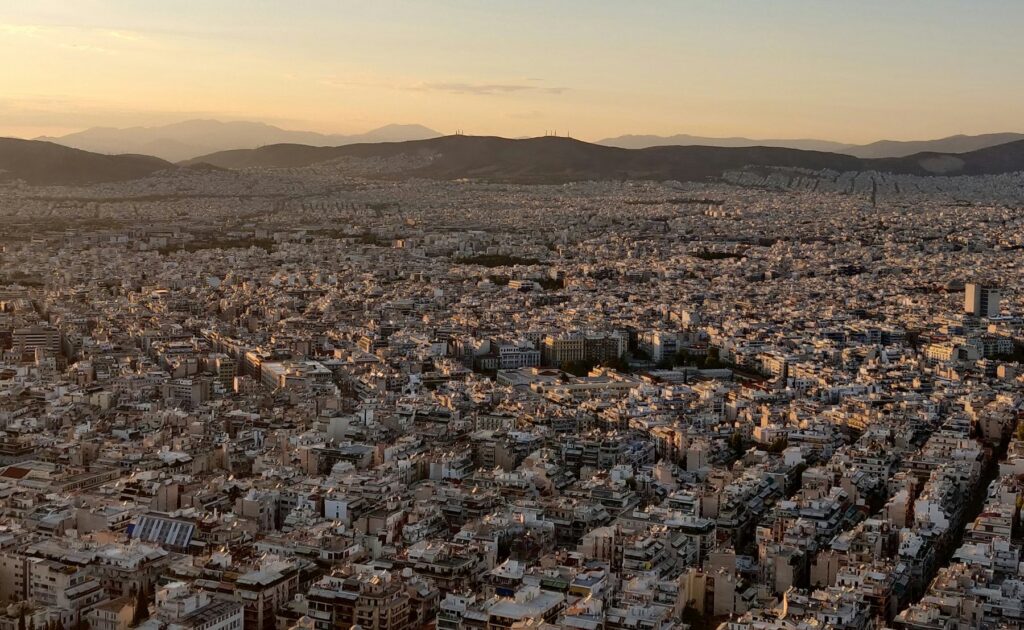
Concrete, asphalt and dark roofs soak up the sun all day. Cities end up hotter than the countryside around them, and at night they no longer cool down: the urban heat island.
A study of 93 European cities found that, in summer 2015, cities were on average 1.5 °C hotter than their surroundings.
Source: Iungman et al., ISGlobal, The Lancet (2023).
The ground in our cities is full. The roofs are empty: thousands of flat roofs, already built, sitting in the sun. Covered with plants and soil, they stop collecting heat. On a summer day, the surface of a green roof can be up to 31 °C cooler than a conventional roof.
Source: US Environmental Protection Agency, Using Green Roofs to Reduce Heat Islands.
The idea
The Great Green Umbrella is a network of green roofs spread across a city, each one a panel of the same umbrella. Alone, a roof protects the people under it. Together, the roofs can help cool streets and neighbourhoods, hold rainwater and bring nature back.
City by city
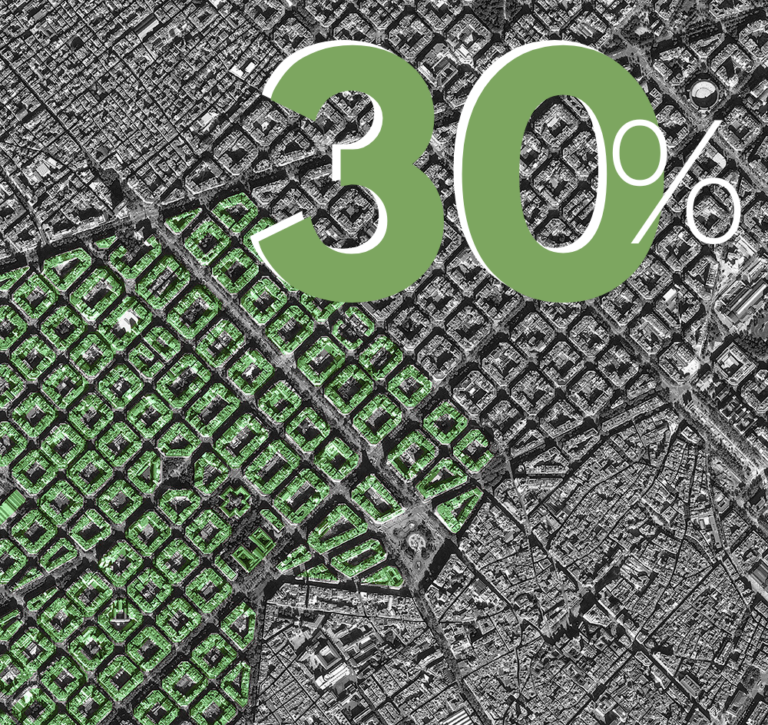
Every city has its own roofs to green. Our goal is the same everywhere: 30% of the roofs that can be greened, by 2050.
Barcelona has 17 million m² of roofs that could be put to use: the equivalent of two Eixamples.
Source: Barcelona City Council.
If we reach our goal:
5 million m²
of new green roofs by 2050: as much green as 16 Parcs de la Ciutadella, without taking a single square metre of ground.
1.5 billion litres
of rainwater held back every year, about 600 Olympic swimming pools, instead of rushing into the drains during a storm.
Estimate: an extensive green roof retains about half of the yearly rainfall (Van Seters et al., 2009; Hill et al., 2017); Barcelona averages 621 mm of rain a year (AEMET).
Milan has 13 million m² of roof surface that could become green, on about 35,000 buildings.
Source: Comune di Milano open data, Decumanus project (satellite survey, 2015–16).
If we reach our goal:
4 million m²
of new green roofs by 2050: as much green as 10 Parco Sempione, without taking a single square metre of ground.
2 billion litres
of rainwater held back every year, about 750 Olympic swimming pools, instead of rushing into the drains during a storm.
Estimate: an extensive green roof retains about half of the yearly rainfall (Van Seters et al., 2009; Hill et al., 2017); Milan averages about 950 mm of rain a year (1991–2020).
Who builds it
Building owners open their roofs. Companies fund roofs in the city where they work. Jungle Roofs and our specialist installers build them.
Green your home or building: we check the roof, find the installer and look for grants.
Currently active in Spain and Italy.